Saturday, 12 February 2022

Mahindra, homegrown automaker unveiled the 'Born Electric Vehicle' platform

Mahindra, homegrown automaker unveiled the 'Born Electric Vehicle' platform


As part of its 'Born Electric Vision' promotion, Mahindra, the native SUV specialist, will reveal up to three all-new electric SUVs.In July 2022, Mahindra & Mahindra will reveal three electric SUV designs, rather than just one. The new designs are part of the company's "Born Electric Vision" campaign, and production vehicles are expected to debut between 2023 and 2025.

Mahindra, homegrown automaker unveiled the 'Born Electric Vehicle' platform


Last year, the homegrown automaker unveiled the 'Born Electric Vehicle' platform, and the dedicated EV architecture will be critical to the company's future chances in the electric vehicle market. While details on the three eSUVs that will be born as part of the company's ambitious initiative are still scant, the leaked teaser video provides us a hint of what to expect in terms of aesthetics from the cars. They are, of course, the creation of Pratap Bose, who joined Mahindra as Executive Vice President and Chief Design Officer in June of last year.

The three electric SUVs that will be unveiled later this year are expected to have aggressive front- and rear-end style, as well as extensive use of LED lighting fixtures. The entire style package will most likely be a development of what we see on the XUV700, which means the vehicles will have sharply carved surfaces as well as an aggressive stance. There is a significant probability that the new EV lineup will include a compact SUV, a mid-size SUV, and an SUV-coupe crossover. These are very certainly cars based on the XUV300, XUV700, and XUV Aero concepts that were revealed a few years ago. These vehicles were created by Mahindra Advanced Design Europe (MADE), the carmaker's design centre in the West Midlands.


The arrival of the new-generation EVs could provide a boost to the Indian automaker, which pioneered the Indian EV industry with eVerito and Maini-based vehicles. However, Mahindra was thereafter seen ceding the lead to Tata Motors after the latter introduced Nexon- and Tigor-based options. However, Mahindra may soon boost the ante with a lineup of electric SUVs that will take on the competition head on.


Join our official telegram channel for free latest updates and follow us on Google News here.


Labels: , , , ,

Thursday, 10 February 2022

Maruti Suzuki electric SUV ,codenamed YY8

Maruti Suzuki's Debut Electric SUV is larger and also has a range of 500 kilometres.

Maruti Suzuki electric SUV YY8

Upcoming new Maruti Suzuki electric SUV (codenamed YY8)


Despite having the largest market share of all Indian carmakers, Maruti Suzuki is yet to enter the electric vehicle industry. This is set to change in 2025, when India's largest automaker is expected to unveil its first all-electric mid-size SUV.

Maruti's mid-size electric SUV (codenamed: YY8) is being developed in collaboration with Toyota, according to a media report. The SUV will be built on Toyota's 27PL'skateboard' platform, which is evolved from the 40PL architecture created exclusively for electric vehicles. It'll be broader and have a longer wheelbase than the Hyundai Creta, according to rumours.
In the future years, Maruti Suzuki and Toyota plan to enter the Indian electric vehicle market. According to a recent media rumour, the two manufacturers are working together on an electric mid-size SUV that will be available in 2025. Suzuki's Gujarat plant will produce the new Maruti electric SUV, which will be shipped to international markets.

The new Maruti electric car is expected to feature a futuristic design language distinct from the company's current IC engine-powered vehicles. It will be built on a 27PL skateboard platform that is based on Toyota's 40PL global architecture. The latter lacks an engine compartment, transmission tunnel, and centre console, allowing designers to create a spacious cabin. Toyota's electric SUV will be built on the same architecture as Maruti Suzuki's electric car, but it will be styled differently.

The new Maruti electric SUV will be longer, wider, and taller than the Creta, which measures 4300mm long, 1790mm wide, and 1620-1635mm tall. It'll be the same size as the MG ZS EV. The new electric vehicle will have a 2,700mm wheelbase. It will have a total length, width, and height of 4275mm, 1880mm, and 1640mm, respectively.

Both 2WD (two-wheel drive) and AWD (all-wheel drive) variants are expected to be available for the Maruti YY8 electric SUV. The 2WD system will be offered on base models with a 48kWh battery pack and a 138bhp electric motor. Under normal test conditions, its range will be roughly 400 kilometres. The 4WD models will have a larger 59kWh battery pack and two electric motors with a total output of 170bhp. It's said to have a range of up to 500 kilometres in real-world situations.

Price

 The new Maruti electric SUV is expected to cost between Rs 13 and Rs 15 lakh due to its high level of localization. It will be less expensive than India's most popular electric car, the Tata Nexon EV, which costs between Rs 14.29 lakh and Rs 16.90 lakh (all, ex-showroom). According to sources, TDSG, a joint venture between Suzuki Motor Corp, Toshiba Corp, and Denso Corp, will supply the battery pack to the Indo-Japanese manufacturer.


Join our official telegram channel for free latest updates and follow us on Google News here.


Labels: , , , , , , , , , ,

Wednesday, 9 February 2022

The Efficiency of a Simple One Electric Scooter Has Increased.

 On August 15, 2021, the Simple One e-scooter was launched in India at a price of under Rs 1.2 lakh.
It'll be known as the Simple One, and the manufacturer has even stated that it will cost between Rs 1.1 and 1.2 lakh. But it's unclear whether this price is ex-showroom or on-road, and whether it includes or excludes subsidies. The worst-case scenario is that this is the after-subsidies ex-showroom pricing. Even if such were the case, the Ather 450X and 450 Plus would still be undercut by the Simple One.

Simple One Electric Scooter


Now Simple One, the Bengaluru-based startup's flagship electric scooter, has got a motor upgrade that improves its performance and efficiency. The company says that their motor's efficiency has increased by 96 percent, as well as its performance and thermal management. The scooter is equipped with a 4.8kW battery pack and a 4.8kW motor that produces 4.5kW of power and 72Nm of torque.

The electric scooter is now touted to accelerate from zero to forty kilometres per hour in 2.85 seconds, which is 0.10 second faster than before. Eco, Rain, Dash, and Sonic are the four riding modes available. It has a top speed of 105 kilometres per hour. The Simple One has a claimed range of over 200 kilometres in Eco mode. It takes 2.7 hours to charge its battery pack from 0 to 80 percent using a home charger. Fast charging allows customers to charge it for 2.5 kilometres in under a minute.

Simple One Electric Scooter


The e-scooter will be manufactured in the first phase at the company's Hosur plant in Tamil Nadu. The factory can produce up to 1 million units per year. Simple Energy has also opened a new plant in Dharmapuri, Tamil Nadu, with a production capacity of 12.5 million units per year. The Simple Loop, the company's public charging network, is located in 13 states throughout the US. These charging stations are set up in collaboration with malls and eateries.


The Simple One electric scooter is priced at Rs 1.09 lakh (ex-showroom) and features a 7-inch touchscreen display with IP67 certification and Bluetooth connectivity. It has a 30-litre storage space under the seat. The e-scooter includes a 200mm disc up front and a 190mm disc in the back for braking. It has a combined braking system as well as a regenerative braking system. A telescopic fork and a monoshock unit are installed at the front and rear axles, respectively.

Simple One Electric Scooter

Join our official telegram channel for free latest updates and follow us on Google News here.


Labels: , , , ,

Tuesday, 8 February 2022

Hyundai EV Kona are priced between Rs 23 lakh and Rs 25 lakh in India

Hyundai EVs are priced between Rs 23.77 lakh and Rs 24.96 lakh (ex-showroom Delhi). It has a maximum capacity of five persons. Hyundai equips the Kona Electric with a 39.2kWh battery pack with a 136 horsepower and 395 pound-feet of torque electric motor. 

Hyundai EV Kona


 Features

  • Virtual Engine Sound System: When the vehicle is in motion, VESS generates an engine sound to ensure pedestrian safety

  • ISOFIX:Convenient and safe way to fix child car seat in the rear

    Hill-start assist control (HAC) lets you get a safe start on an uphill incline without rolling backwards.

  • Vehicle Stability Management:VSM avoids loss of control during sudden braking or rapid accelerating under asymmetric road conditions

  • Six Airbags:Uncompromising approach to safety engineering. Dual front airbags, front seat side- impact and side curtain airbags work together with the seat belts to take the safety of the vehicle to an un-parallel level.

  • EV Menu Screen:On 17.77 cm touchscreen display, you can find out Energy information, Power consumption, Eco driving and charge management. All information you want to know about your electric vehicle is just a touch away.

  • Apple CarPlay and Android Auto: Connect your smartphone and have your music, phone and app functions up on the main screen.

  • Power meets Style:Power never looked so stylish. A zero emission electric SUV that delivers instant acceleration and power with over an overwhelming 452* km range on a single full charge.

  • AC Wall Box Charger: 7.2 kW Wall-mounted charger is installed at home or office premises for faster charging. It takes almost 6 h 10 min for a full charge.

  • Portable Charger: car is equipped with an in-cable control box (ICCB) that you can plug right into a normal wall socket. It will take 19 h for a full charge.

  • DC Quick Charger CCS Type 2 :50 kW KONA Electric can be charged at DC fast charging stations. Charges up to 80 percent in less than 1 h (57 min) .It takes less time than your smart phone needs to charge


The Kona Electric has a range of 452 kilometres and can sprint from 0 to 100 kilometres per hour in 9.7 seconds, according to ARAI testing. In 57 minutes, the 50kW fast charger can charge the battery to 80% capacity. A complete charge of the 7.2kW AC wall-box charger for household installation takes 6 hours and 10 minutes. It also includes a compact, portable 2.8kW charger that can be put into a standard wall outlet to fully charge the Kona Electric in about 19 hours.

Hyundai EV Kona


It is equipped with a single-speed transmission. Eco, Eco+, Comfort, and Sport modes can be used to change the driving characteristics. The amount of regenerative braking is controlled via paddles behind the steering wheel. Sunroof, automatic air conditioning, wireless phone charging, ventilated front seats, rear AC vents, and cruise control are all included. A 10-way power-adjustable driver's seat with lumbar support, 17-inch alloy wheels, LED bi-functional headlights, LED DRLs, LED tail lamps, and roof rails are also included.

Six airbags, vehicle stability management, electronic stability control, hill assist control, disc brakes on all four wheels, ISOFIX child seat anchorage, a rear camera, and a tyre pressure monitoring system are all standard on the Hyundai Kona Electric. It also features a simulated engine sound system that warns passersby of impending danger.

The MG ZS EV is its only direct competitor. Check out the sub-4m Tata Nexon EV if you're seeking for a more cheap electric SUV. Hyundai is also developing a mass market electric vehicle for India, which is anticipated to debut in 2024.

Exterior

The Kona EV's dimensions are midway between the sub-4-meter Hyundai Venue and the mid-size Hyundai Creta. It's 20mm shorter than Hyundai's new baby SUV, while being longer, wider, and having a longer wheelbase than the Venue

Dimensions Kona EV Venue Creta
Length 4180mm 3995mm 4270mm
Width 1800mm 1770mm 1780mm
Height 1570mm 1590mm 1665mm
Wheelbase 2600mm 2500mm 2590mm 


The Kona is broader and has a longer wheelbase than the Creta, but it is shorter in length and height. No, you won't have the same dominant road presence as comparable priced competitors. To be honest, the crossover posture and curving appearance make it look like a larger, more purpose-built version of the i20 Active.

Two aspects will primarily attract attention to the Kona EV. First and foremost, there's the outlandish design. The Kona electric looks fascinating, if not gorgeous, thanks to its false front grille (where the charging port is hidden) and uniquely shaped 17-inch alloy wheels, as well as the striking black body cladding, especially on the rear fender.

The car's rarity is the second eye-catcher. Even a year from now, the Kona is unlikely to be as prevalent as a Jeep Compass or a Tata Harrier. As a result, any eyes that turn your direction will do so out of curiosity and intrigue.

The LED projector headlights positioned in the bumper (a la Venue), the LED DRLs up top, and the LED tail lamps are just a few of the design features.

Interior 

 The quality is top-notch and consistent, as is characteristic with Hyundai car interiors, and all of the controls are as simple to operate as they are in the Tucson. This is where the Kona EV's allure resides. Most people who are interested in the Kona have never driven or even been in an electric vehicle before, yet once inside, nothing looks strange. 

Hyundai EV Kona

Hyundai EV Kona

Hyundai EV Kona


 Everything from the drive mode button (Eco, Eco+, Sport, and Comfort) to the button-type drive selection (park, neutral, reverse, and drive) falls into your hand with ease. In comparison to the Tucson or Creta, the Kona EV's centre console is raised and finished in a dull silver finish. When you add in the low-slung seats, you have a driving posture that's similar to that of a hatchback or sedan. It's not like the Venue or Creta, where your line of sight is above the bonnet. 

 Kona EV’s this isn’t a very big car, low height doesn’t present any issues for headroom, drivers over 6ft tall will have to set the driver’s seat height at a lower point. The cabin capacity, especially in the back, is comparable to several premium hatchbacks priced under ten lakh rupees. 

While the rear knee room and headroom are adequate for 6-footers, they aren't as generous as those found in petrol/diesel-powered SUVs at the same price point. The proximity of the seat base to the floor is a significant issue in the back. Because the seated position forces your knees up, even individuals under 6 feet tall will be unable to use the underthigh support. 

Some facts must be confronted: If the Kona EV had been produced in India, it would have surely been cheaper. It is currently produced in the United States using imported parts, which explains why it is priced similarly to larger vehicles. In fact, it's less expensive in India than in Hyundai's home market of South Korea, and even Hyundai India recognises that this isn't a profitable model. 

It's only to put things in perspective: this isn't supposed to compete with the huge SUVs, and its pricing reflects how it's built for sale in India. While the Tucson has 530 litres of trunk capacity, the Compass has 438 litres, and even the Creta has 402 litres, the Kona EV only has roughly 334 litres. Although this is less than the new WagonRs, it is still sufficient for two large luggage. 

 Safety and Performance 

Six airbags, ABS with EBD, ISOFIX, vehicle stability management, electronic stability programme, and traction control are all standard on the Hyundai Kona electric. Hill start help, rear parking sensors, a rear camera with dynamic guidelines, auto headlights, and tyre pressure monitoring are among the other features. The torque delivered by electric cars is instantaneous. 

50kW DC Fast Charger 7.2kW AC wallbox charger 2.8kW Portable Charger
57 minutes for 80 per cent charge 6 hours & 10 minutes for 100 per cent charge 19 hours for 100 per cent charge

Hyundai EV Kona


There's no need to wait for an engine to rev up to a set rpm, and there's no gearbox to shift up through. When you slam the throttle from a standstill or even while driving at 50 kph, all 395Nm is immediately committed to the road. The Kona EV accelerates quickly and easily surpasses 100 kilometres per hour. The ARAI claims that the Kona EV has a range of 452 kilometres on a full charge. 

The Kona EV is available in two versions in the international market: a 39.2kWh battery with a 100kW electric motor and a 64kWh battery with a 150kW electric motor. India receives the smaller battery, which, according to European ratings, has a claimed range of 345 kilometres, which is the same as what we get in India. The difference lies in the technique of testing. 

The NEDC approach allows top speed testing at 120 kmph, however the ARAI method does not allow the top speed to exceed 50 kmph. The India-spec Kona EV has a significantly longer full charge range due to the difference in average speeds in the test cycles (determined based on the average drive cycles of the two areas).


Join our official telegram channel for free latest updates and follow us on Google News here.


Labels: , , , , , , , , , , , , , ,

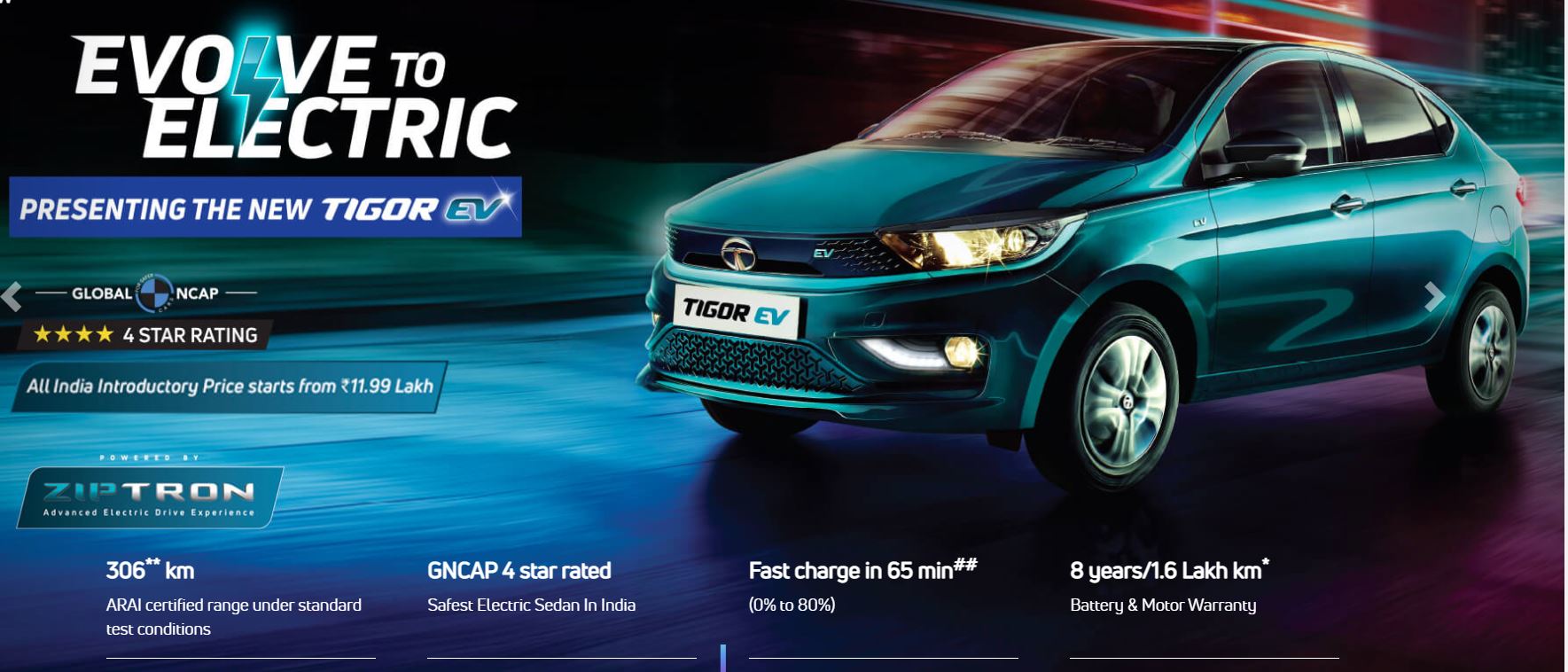
Tigor EV, The smallest sedan from Tata has become India's most cheap electric vehicle.

Tata Tigor EVElectric vehicles are finally reaching the mainstream market. You don't have to spend more than Rs 20 lakh to get your hands on one that you can use every day. This transformation is being led by Tata. The Nexon EV has become India's electric vehicle poster boy.

The Tigor EV is the sequel to this drama, and it is now the most cheap electric four-wheeler available in India for individual usage. Is it enough to persuade you to join the electric train? Or are there any major stumbling blocks in your way?


Features

  • Over The Air software updates for telematics unit
  • Safest electric sedan in India with 4-star GNCAP rating
  • IP67 certified battery, motor and power electronics components
  • AIS 048 (Nail penetration), crush test, overcharge protection, shock protection, short circuit protection, as per global standard for safety and reliability
  • 8 years / 1.6 lakh km* warranty on battery and motor
  • Built on the Ziptron EV platform, that has been driven and proven over 35 mn.^ km in diverse Indian conditions
  • Tata Motors ZConnect app powered by iRA offers 30+ connected car features
  • Key features include remote commands, vehicle health monitoring, safety and security, driving and trip analytics, and location-based services
  • Seamless Charging Experience
  • Free home charging installation*
  • 24x7 emergency charging support (in 5 cities)


As a true embodiment of the electric evolution, the new Tata Motors electric car – Tigor EV houses a supremely ample 26 kWh lithium-ion battery pack. This IP67 certified (Ingress Protection against intrusion, dust, accidental contact, and water) battery has been driven and proved over 35 mn.^ km in order to brave any terrain and any weather. Feel the power of Ziptron technology surge through the Tata Tigor EV as you turn on the ignition. 

Pure, pristine power propels Tata Motors’ latest electric sedan at a peak output of 74.7 PS and a torque of 170 Nm for an excellent driving range. Expect nothing less from our Permanent Magnet Synchronous Motor.It’s only fair to complement this battery capacity with a high-performing motor controller that is integrated with Ziptron technology to fire up this electric sedan. Complete with its liquid cooled architecture for a powerful performance and durability over a wide range of operating temperatures.


Performance


Powering the Tigor EV is a 26kWh battery pack. The new ‘Ziptron’ powertrain means there’s a permanent synchronous motor (75PS/170Nm) powering the wheels and not an old school 3-phase AC induction motor that does duty on the Xpres-T (Tigor EV for the taxi market). 

Tata Tigor EV


In a little over an hour, you may charge up to 80% of the Tigor EV's battery, as is the case with other modern EVs. This necessitates a 25kW DC fast charger, which can be found at public charging stations in cities and along national highways, as well as certain Tata dealerships and even some gasoline and diesel pumps.

To charge the Tigor EV at home with a conventional 15A outlet, you'll have to wait roughly 10 hours to get the battery from 0% to 100%. To ensure battery life and performance, Tata suggests charging the battery to 100 percent at least once a week rather than relying solely on rapid charging. It's comforting to know that the battery pack comes with an 8-year/160,000-kilometer manufacturing warranty.


Safety


The Tigor EV gets dual airbags, ABS with EBD, and corner stability control as standard. It also is the first electric vehicle to be crash-tested by the Global NCAP, where it secured a respectable 4 stars for both adult and child occupant safety.

Tata Tigor EV

This budget electric car in India boasts of a liquid cooled, IP67 certified (Ingress Protection against intrusion, dust, accidental contact, and water) and AIS-048 safety standard compliant battery pack that checks all boxes for protection against nail penetration, crush, overcharge, and short circuits. It can withstand a wide range of temperatures while simultaneously being waterproof and dustproof.

Tata Tigor EV


Feel truly safe in our electric cars that come with Anti-Lock Braking System, Electronic Brake-Distribution System and Cornering Stability Control. Stay completely in charge on the road.
 

Exterior


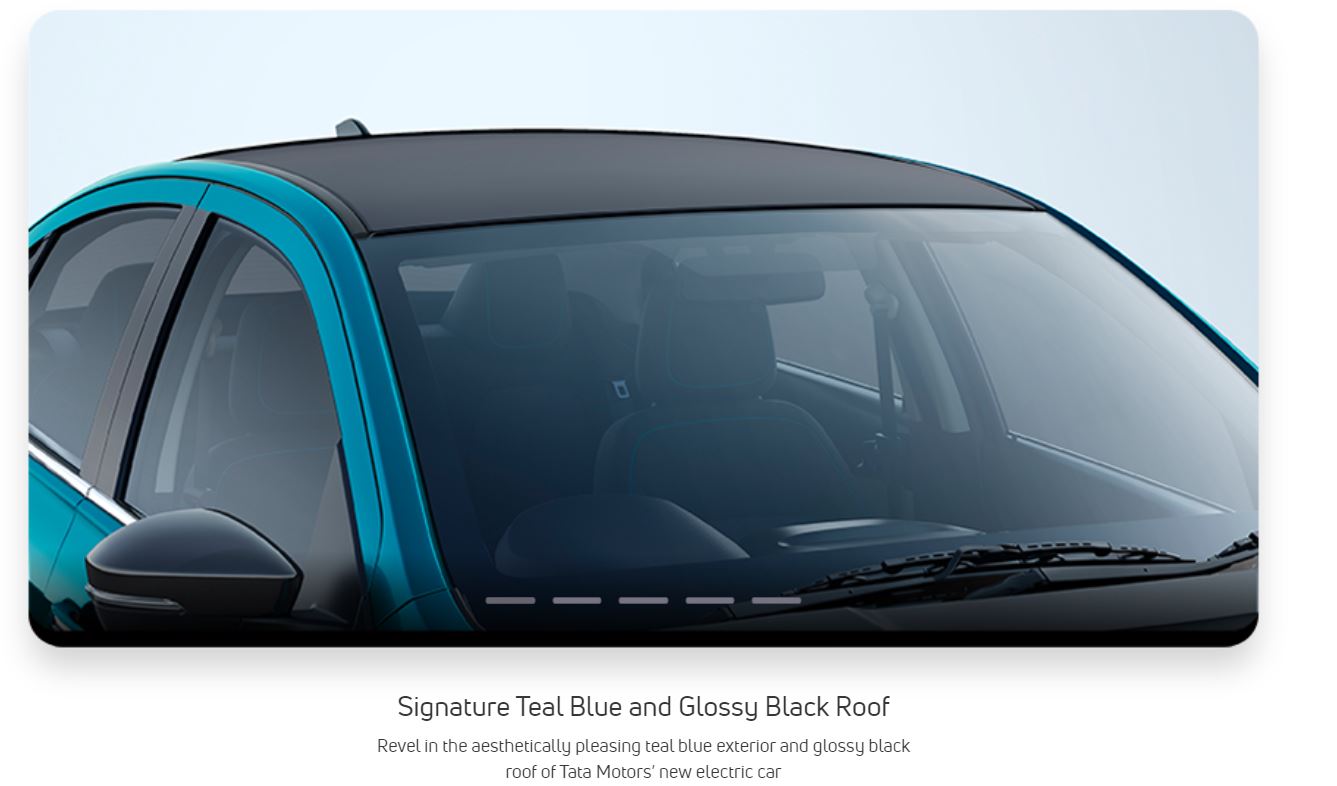
The Tigor EV makes a subtle statement. The rich Teal Blue colour is a dead giveaway, to be sure. However, a short glance at the Daytona Grey colour option reveals that Tata is only nudge you to notice the difference rather than screaming it in your face.

Tata Tigor EV


The grille has been reworked with 'tri-arrow' decoration, and the front bumper has more of the same. The matte aqua-color accents around the grille, fog lamps, and wheels, as well as the faint highlights on the bumpers, are the only design differences between an electric Tigor and its fuel counterpart. We appreciate how Tata has used chrome sparingly here, with an underline for the window line, a splash on the door handle, and a splash on the boot. Highlight elements like the halogen projector headlamps, daytime running lamps, and clear lens tail lamps have been carried over unchanged.

Tata Tigor EV


The wheels are a noticeable difference from the petrol Tigor. The EV must make due with 14-inch steel wheels that attempt to imitate alloy wheels. It doesn't help that the design is nearly identical to the Tiago NRG's previous iteration. The Tigor's 15-inch two-tone alloy wheels would have looked great here.

Interior


The Tigor's robust design clearly benefits the electric vehicle. If you like to make a statement, the Tigor EV does it in a variety of ways.

Tata Tigor EV

Tata Tigor EV


And for some, that may be a letdown. On an entry-level vehicle that costs less than Rs 10 lakh, the rough and scratchy plastic is tolerable. Tata might have improved the overall experience by including a leather-wrapped steering wheel, leatherette seat upholstery, and door mats.

Tata Tigor EV


Thankfully, space and utility have not been compromised. With a height-adjustable driver's seat and steering tilt-adjust, getting into a comfortable driving posture is pretty simple. The Tigor EV, like the normal car, offers enough room for four six-footers. You can fit a third occupant in the back seat if everyone isn't as tall. Also, at this price point, rear-adjustable headrests and rear AC vents feel like foolish omissions.


Tata Tigor EV

Join our official telegram channel for free latest updates and follow us on Google News here.

Labels: , , , , , , ,

Monday, 7 February 2022

Hyundai SUV electric: Ioniq 5 will be launching on Jun 2023.

 Hyundai has dabbled in battery-powered EVs ahead, but now with the launch of the Ioniq 5 the Korean brand is going each- by, with a new devoted platform, innovative features, and a veritably enterprising design language.


 Hyundai gets serious about EVs with the Ioniq 5, bringing a daring design to the fight
. The Ioniq 5 is a" mean CUV" according to Hyundai, and it's grounded on the each-newE-GMP platform that the group designed specifically for use in battery electric vehicles. The name point in the spec list is the 3m (118- inch) wheelbase (aka the distance between the front and hinder bus). This is further than you'd typically anticipate for a auto in this class, with a total length of4.635 m (182.4 elevation). The expanded wheelbase allows for added comfort outside, including ample space for those traveling on the backseat.

 Hyundai gets serious about EVs with the Ioniq 5, bringing a daring design to the fight
. The new auto is being offered with hinder wheel drive or all wheel drive options. The Long Range model gets a72.6 kWh battery (77.4 kWh for North America). With the base model that has a hinder motor, you get 350 Nm of necklace and 160 kW of power (214 hp), for a 0-100 km/ h (0-62 mph) time of7.4 seconds. 


Hyundai gets serious about EVs with the Ioniq 5, bringing a daring design to the fight
. Splurge for the binary motor AWD interpretation, and you are getting 225 kW of power (301 hp), 605 Nm of necklace, and a 0-100 km/ h (0-62 mph) time of5.2 seconds.
 
 The Standard Range model has a 58 kWh battery, and in the 2WD configuration comes with 125 kW of power (167 hp), 350 Nm of necklace, and does 0-100 km/ h in8.5 seconds. Go for the AWD option and you get 173 kW (231 hp), 605 Nm of necklace, and6.1 seconds to go from 0 to 100. The top speed for all variants is limited to 185 km/ h (115 mph).

 Hyundai gets serious about EVs with the Ioniq 5, bringing a daring design to the fight
. The maximum range in the WLTP cycle is 470-480 km with the Long Range powertrain with 2WD. The Ioniq 5 supports both 400V and 800V charging structure with no need for fresh appendages. At the fastest DC dishes that it supports, which are 350 kW, it can go from 10 to 80 in 18 twinkles, and add 100 km (62 country miles) of range in 5 twinkles of charge. You just need to be lucky enough to find a 350 kW bowl to reach these figures, and those are still relatively rare. 

 Hyundai gets serious about EVs with the Ioniq 5, bringing a daring design to the fight. In the box you will find 531l of space, which extends to l when the backseat is folded. There is a frunk too, which varies in capacity-24l for North American models, 24l for rest of the world models with AWD, and 57l for 2WD.

 Hyundai gets serious about EVs with the Ioniq 5, bringing a daring design to the fight
. Inside you get two 12- inch defenses, one in front of the motorist, one in the center part of the gusto, and an AR HUD. The center press can slide back over to 14 cm (5.5 elevation) for" further freedom of movement"inside the vehicle. 


For interior colors, you can pick between Obsidian Black and Dark Pebble Gray/ Dove Gray and Dark Teal/ Dove Gray, an fresh Terra Brown/ Mud Gray option will only be available in Korea. For the outside, the options are Graveness Gold Matte, Firing- Star Gray Matte, Digital Teal-Green Pearl, Lucid Blue Pearl, Atlas White, Cyber Gray Metallic, Phantom Black Pearl, Galactic Gray Metallic, and Mystic Olive-Green Pearl. The last two of those will not be offered in North America.
 
 Optionally, you can equip the auto with a solar roof, which will charge the battery and ameliorate effectiveness, although do not anticipate record- breaking figures then.
Hyundai gets serious about EVs with the Ioniq 5, bringing a daring design to the fight. The Ioniq 5 is priced from£ in the UK, and in some requests like Europe you'll get a 5- time unlimited bond. The battery is bond defended for 8 times or km ( country miles), whichever comes first.
 
 The Ioniq family is just getting started-the Ioniq 6 will be a hydrofoil and the Ioniq 7 will be a large SUV, both electric, and both coming soon. 


Join our official telegram channel for free latest updates and follow us on Google News here.


Labels: , , , , , , , ,

Sunday, 30 January 2022

Tata Sierra EV Concept marks the return of a Tata Motors Living Legend

Sierra EV Concept
Sierra EV Concept
Sierra EV Concept

The Tata Sierra EV Concept marks the return of a Tata Motors Living Legend.

The Sierra Concept is a forward-thinking, innovative, and upbeat look at the future of SUVs, now available in an electric form. It's a vehicle that wonders what the SUV's future holds. What does mobility's future hold? What role will this product play in shaping the storey of a world that is both sustainable and responsible? Finally, it reintroduces the romance and soul of one of Tata Motors' most iconic names. This is a vision that both looks back and forward.
Sierra EV Concept
Sierra EV Concept


The Sierra EV Concept builds on the IMPACT 2.0 design language, delivering vehicles that are sleek and represent Tata Motors' contemporary design aesthetic. It's a 4.1-meter SUV that's the third car to be built on the new 'Agile Light Flexible Advanced' (ALFA) Architecture and is a fully electric vehicle. The Sierra Concept's design is dynamic and focused on the outside while giving class leading space and utility on the inside, encapsulating the soul of the sophisticated customer.

On the outside, the Sierra has a functionally focused design that reflects the customer's busy lifestyle. The Tata Design team has created a product that is modern, advanced, and yet preserves the essence of the original Sierra's classic posture and window graphics. It is created with subtle minimalism and is well balanced and poised. It can be used as both a tough all-around SUV and a mobility solution. The Impact 2.0 humanity line is echoed on the front face, but it is reinterpreted in a new way to reflect the EV identity. There is a balance between 'tough tech' on the bottom of the car, which is expressed in the cladding, platform, and powertrain, and 'flush tech' on the top, which emphasises quality ,seamless surfaces, and refinement.
Sierra EV Concept

The interior design focuses on making the space feel expansive and stress-free. The rear passenger arrangement emphasises space, comfort, and safety, resulting in a welcoming environment. With a signature lounge arrangement for the rear passengers and the possibility for the front passenger to spin and share this space, it offers a unique and pioneering approach to mobility. They will appreciate the wide panoramic windows and skylight in this room. Instead of a rush to add more screens, the dashboard gives a natural hardwood tech shelf with the option for customers to bring their own device. This adds to the Tata Sierra's digital detox by establishing an environment where users can communicate with one another while taking in the scenery.
Sierra EV Concept


These principles are emphasized by the colors of the materials utilized throughout the Sierra Concept. The exterior color is a faint pearlescent "off white" that matches the front and rear lamp graphics, which signify modernity and the digital generation without appearing distant. The concept continues inside, with wood grain contours emphasising delicate light curves and a pleasant ambience. On second glance, you'll see an abundance of visual and tactile features, like subtle Jaali textures, off-white knit and geometric embossed cloth, moss, and, most importantly, etched patterns on recycled leather portions that convey the Sierra tale.


Sierra EV Concept


The pursuit of utopia. The concept that good design may enhance the human condition. The Tata Sierra Concept is based on this philosophy. That is the way transportation will be in the future.

Technical Specifications

Sierra EV Concept Technical Specifications


Join our official telegram channel for free latest updates and follow us on Google News here.


Labels: , , , , , , , , ,

Wednesday, 29 December 2021

Tata Altroz EV will be expected to launch on Jun 2022.

 The all-new Altroz EV is based on the Altroz hatchback, Tata Motors' first product designed on the futuristic and adaptable 'Agile Light Flexible Advanced' (ALFA) Architecture, and it represents the company's radical new design approach. The Altroz EV is a luxury city automobile that has been designed to fulfil the changing needs of customers.

Tata Altroz EV


The Advanced Concept of the Altroz EV is based on the Altroz premium urban automobile, which is built on the ALFA Architecture's lightweight, modular, and flexible qualities, allowing it to expand into a variety of modern, youthful, and agile cars in a short development cycle.

The Altroz EV is a dynamic vehicle that reinvents the city automobile and resets the rules for the industry catering to the mature client, based on the successful 45X concept from Auto Expo 2018. The Altroz EV is a mix of futuristic design, smart technology, intuitive connectivity, and exceptional performance, with a stronger emphasis on integrating connectivity and everyday mobility together.


Tata Altroz EV


KEY HIGHLIGHTS

  • Energy efficient powertrain unit
  • High energy density battery pack offering superior range
  • Sporty silhouette, athletic stance and aerodynamic lines give the Altroz EV a feeling of agility
  • Signature humanity line accentuated by dual ultra slim LED headlamps, along with a digitally inspired lower grill give the front of the Altroz EV its signature look
  • The side profile features a unique arrowhead forming at the intersection of the A-pillar with the front door flowing into the one-of-a-kind comet tail-like swoosh element along the window line
  • The interiors of the Altroz EV have been laid out like a modern aero command centre with a seamless cockpit-like theme connected from end-to-end
  • The use of large coloured displays, enhanced haptics and premium materials gives a feeling of being in a premium environment from the future
    Tata Altroz EV


TECHNICAL SPECIFICATIONS


Tata Altoz EV TECHNICAL SPECIFICATIONS

EV Engine and specification:

The Tata Altroz EV could be powered by the same battery pack that powers the Nexon EV. The model will, however, most likely have a varied power output and driving range. The driving range may be north of 300 kilometres.

Exterior design:

The EV version is projected to have a revised grille, a modified air dam, a new teal blue colour, electric blue highlights all around, and no exhaust pipe at the back, as opposed to the ICE-powered Altroz.

Interior and features:

The Tata Altroz EV's interior is believed to be nearly identical to its ICE equivalent. The absence of a mechanical gearbox, which will result in extra space around the centre console, is the only change we expect.

Seating capacity:

The upcoming Tata Altroz EV will have a seating capacity of five occupants.


Join our official telegram channel for free latest updates and follow us on Google News here.


Labels: , , , , , , , , , ,

Sunday, 5 December 2021

Four months after launch, Ola finally has a delivery date for its scooter

 Ola Electric has finally started delivering the Ola S1 series after several delays. However, it's possible that you won't get all of the features out of the box when it arrives.

The wait may finally be over for those looking to own Ola’s first-ever electric scooter.

Ola Electric will begin delivering the S1 and S1 pro from Dec. 15, CEO Bhavish Aggarwal said on Twitter on Dec. 4. Ola launched the two variants in August, looking to begin deliveries in October.

The second purchasing opportunity for the e-scooter will open near the end of January next year. Read our storey for more information. In the future, Ola Electric hopes to release a more affordable electric scooter and an electric motorcycle. More information is available in our report.

In August, the Ola S1 and S1 Pro electric scooters were released in India. The former would set you back Rs 99,999, while the latter will set you back Rs 1,29,999. (ex-showroom, Bengaluru).

Ola Electric Bike

 Both the Ola S1 and the Ola S1 Pro come with all-LED lighting, a spacious 36-litre underseat storage compartment, a TFT instrument cluster with smartphone, Bluetooth, Wifi, and GPS connectivity, and a TFT instrument cluster with smartphone, Bluetooth, Wifi, and GPS connectivity. Side-stand-down and anti-theft warning are among the other basic features, as are geo-fencing, reverse mode, Get Home Mode, Take Me Home Lights, and a Limp Home Mode.

Hill-hold, voice assistant, and cruise control are all included in the S1 Pro model. The e-scooter also has several profiles and a sound system that mimics the sound of a gasoline-powered scooter, comparable to the Revolt RV 400. However, most of the features are now unavailable to consumers and will be provided as an OTA update later.

Ola Electric Bike

The Ola S1 and S1 Pro both use the same permanent magnet motor, which produces 8.5kW of peak power and 58Nm of peak torque (at the shaft). The S1 Pro has a top speed of 115 kmph, whereas the S1 is limited to 90 kmph. It's powered by a 2.98kWh or 3.97kWh lithium-ion battery pack with 121km and 181km of range, respectively. The e-scooters can be charged in 4 hours and 48 minutes using a household charger (6.5 hours for the S1 Pro). Ola's Hypercharger network can provide a 75-kilometer range in 18 minutes of charging.

Ola Electric Bike

The curving battery pack is situated on the floorboard and is built on a tubular frame. It is supported at the front by a single-sided fork and at the back by a monoshock with a single-sided swingarm. A 220mm front and 180mm rear disc with standard CBS bring the electric scooter to a standstill. For Indian roads, the 165mm ground clearance is sufficient. It is equipped with 12-inch alloy wheels with 110-section rubber on both ends. The e-scooter is rather heavy, with the base model weighing 121kg kerb and the S1 Pro weighing 125kg kerb.

Ola Electric Bike


The Bajaj Chetak, TVS iQube Electric, and the Ather 450 Plus are also competitors for the Ola S1. The Ola S1 Pro, on the other hand, is up against the Ather 450X and the Simple One. In this price range, the TVS Apache RTR 200 4V, Yamaha FZ25, Hero XPulse 200, and Suzuki Gixxer SF are all viable alternatives to the Ola S1 Pro. The Yamaha FZ-Fi, Bajaj Pulsar NS125, or Aprilia SR 125, on the other hand, are all around the same price as the Ola S1 model.


Join our official telegram channel for free latest updates and follow us on Google News here.


Labels: , , , , , , ,

Wednesday, 1 December 2021

Expected launch date of Tesla Model S in India is Mar 01, 2023.

Tesla India Motors And Energy Private Limited is a Tesla Inc. subsidiary that handles the company's Indian activities. On January 8, 2021, the company was incorporated in Bengaluru, Karnataka.  Elon Musk, Tesla's CEO, stated on Twitter that the company had formally registered with the Registrar of Companies in India at its Bengaluru office. Nitin Gadkari, India's transport minister, has announced Tesla's arrival in the country.

 
Tesla India Motors And Energy Private Limited


Model S

  • Cinematic Display, 17" The redesigned centre display is the greatest screen to view anywhere, with 2200x1300 resolution, extremely bright, genuine colours, and amazing responsiveness.
  • No stalks, no shifting, just pure driving attention. The Model S is the best automobile to drive and to be driven in.
  • Cabin air conditioning that is clean, strong, and virtually undetectable. Standard features include tri-zone climate control, ventilated front seats, and HEPA filtration.
  • Extra legroom, headroom, and a stowable armrest with integrated storage and wireless charging for three persons.
  • With up to 10 teraflops of processing power, in-car gaming can compete with today's most powerful consoles. You can play from any seat thanks to the wireless controller compatibility.
  • Every passenger has access to multi-device Bluetooth, wifi, and USB-C charging, with enough power to quickly charge tablets and laptops.
  • Model S is a luxury car with front and rear trunks and fold-flat seats that can fit your bike and luggage without taking the wheel off.
  • It is expected to be priced at Rs 1.5 crore (ex-showroom).

 
Tesla Model S Powertrain, offers three electric options for the international-spec Model S: Long Range, Plaid, and Plaid+. While the Long Range model has a dual-motor arrangement with a stated range of over 660 kilometres, the Plaid and Plaid+ models have a tri-motor setup with claimed ranges of 627 kilometres and 837 kilometres, respectively. All models are equipped with all-wheel drive. Each variation can sprint from 0 to 96 kilometres per hour (0-60 miles per hour) in 3.1, 1.99, and less than 1.99 seconds, respectively.

Tesla India Motors And Energy Private Limited


Up to 21-inch alloy wheels, a glass roof, two wireless smartphone charging pads, and a 22-speaker 960W audio system are included in the Model S. Tri-zone climate control, ventilated front seats, a 17-inch touchscreen infotainment system, and an 8-inch touchscreen system for the rear passengers are all included.

Tesla India Motors And Energy Private Limited

Safety High Impact Protection


Model S is designed from the bottom up to be an electric car, with a high-strength architecture and a floor-mounted battery pack for exceptional occupant safety and reduced rollover danger. Tesla's latest active safety technologies, such as Automatic Emergency Braking, are included in every Model S at no additional cost.

Tesla Model S


Under your active supervision, Autopilot allows your car to steer, accelerate, and brake automatically inside its lane, supporting you with the most difficult aspects of driving. The most recent enhancements are available immediately with over-the-air software updates.

 Tesla Model S will be competed with Phantom, Ghost, Rolls Royce Dawn, SF90 Stradale, Rolls Royce Wraith.


Labels: , , , , , , , , ,

Sunday, 21 November 2021

Porsche Taycan Cross Turismo is to take you off- road

 Porsche has a new Taycan EV, and it's bigger and out- road-ier than the original model. Meet the Taycan Cross Turismo. An estate (but do not call it that), although it's got adaptive air suspense for" exacting dynamics off- road", 36 mm (1.4 elevation) further headroom for the hinder passengers, and a total cargo capacity at the reverse of l (42 cu ft) with the hinder seats folded. So like an electric Porsche interpretation of the Audi Allroad Quattro idea.


 Porsche Taycan Cross Turismo is then to take you off- road with high hinder passengers
 It uses the same 800V armature as thenon-Cross Turismo Taycan, and it fits a93.4 kWh battery on all four variants that are launching now. This supports 11 kW AC charging by dereliction, or 22 kW if you pay further for an voluntary redundant. Charging via the fastest supported DC dishes (270 kW) will give you 100 km (62 country miles) of range in 5 twinkles, or let you go from 5 to 80 in 23 twinkles.


 Porsche Taycan Cross Turismo is then to take you off- road with high hinder passengers
 The entry- position model is the Taycan 4 Cross Turismo, which makes 280 kW (380 PS) of power and can"overboost"for launch control up to 350 kW (476 PS), for a 0-100 km/ h (0-62 mph) time of5.1 seconds. It has a top speed of 220 km/ h (136 mph), and a range in the WLTP cycle of 389-456 km (241-283 country miles).
 Also we've the Taycan 4S Cross Turismo, with 360 kW (490 PS) of power, overboost to 420 kW (571 PS), 0-100 km/ h in4.1 seconds, a top speed of 240 km/ h (149 mph), and a WLTP range of 388-452 km (241-280 country miles).
 
 Porsche Taycan Cross Turismo is then to take you off- road with high hinder passengers
 The Taycan Turbo Cross Turismo makes do with 460 kW (625 PS) of power, can overboost that to 500 kW (680 PS) for launch control, accelerates from 0-100 km/ h in3.3 seconds, has a top speed of 250 km/ h (155 mph), and a WLTP range of 395-452 km (245-280 country miles).

 Eventually, the Taycan Turbo S Cross Turismo has the same power figures as the Turbo, but can overboost advanced to 560 kW (761 PS) for a 0-100 km/ h time of2.9 seconds. The top speed is the same too, but the WLTP range is slightly different 388-419 km (241-260 country miles). 


 Porsche Taycan Cross Turismo is then to take you off- road with high hinder passengers
All models have each-wheel drive and an voluntary Off- Road package will increase ground concurrence by over to 3 cm (1.18 elevation) to let the auto also be driven"on demanding out- road terrain". Commodity called Gravel Mode is fitted as standard and improves driving on rough roads.


 On the inside, you get a familiar design if you've ever seen the vanilla Taycan, with sect- shaped upper and lower sections of the dashboard, that stretch across the entire range of the auto. There is a free- standing, twisted instrument cluster, a central10.9- inch infotainment display, and an voluntary front passenger display too which combine in a glass band in a black- panel look.


Porsche Taycan Cross Turismo is then to take you off- road with high hinder passengers
 The Taycan 4 Cross Turismo and Taycan 4S Cross Turismo have 446l (15.7 cu ft) of space in the charge/ box, that grows to l (42.8 cu ft) with the hinder seats folded. The Taycan Turbo Cross Turismo and Taycan Turbo S Cross Turismo have 405l (14.3 cu ft) of box/ charge space, that grows to l (41.3 cu ft) with the hinder seats folded.
 
Porsche Taycan sedan rivals its Audi sibling, the e-tron GT, which is priced from Rs 1.80 crore to Rs 2.05 crore (ex-showroom-India). The Taycan Cross Turismo, meanwhile, has no direct competitors and instead will face competition from electric luxury SUVs like the Audi e-tron and e-tron Sportback, Jaguar I-Pace and Mercedes EQC.  


Join our official telegram channel for free latest updates and follow us on Google News here.


Labels: , , , , , , , , , ,

Tuesday, 31 August 2021

2021 Tigor EV is priced from Rs 11.99 lakh to Rs 13.14 lakh

The highly-awaited Tata Tigor EV will be launched in the country on August 31, 2021. Here's what you can expect from the new electric subcompact sedan.

2021 Tigor EV


 Electric vehicles are finally reaching the mainstream market. You don't have to spend more than Rs 20 lakh to get your hands on one that you can use every day. This transformation is being led by Tata. The Nexon EV has become India's electric vehicle poster boy.

The Tigor EV makes a subtle statement. The rich Teal Blue colour is a dead giveaway, to be sure. However, a short glance at the Daytona Grey colour option reveals that Tata is only nudge you to notice the difference rather than screaming it in your face.

The grille has been reworked with 'tri-arrow' decoration, and the front bumper has more of the same. The matte aqua-color accents around the grille, fog lamps, and wheels, as well as the faint highlights on the bumpers, are the only design differences between an electric Tigor and its fuel counterpart. We like how Tata has kept the chrome to a minimum here: an underlining for the window line, a splash on the door handle and boot — just right. Highlights such as the halogen projector headlamps, daytime running lamps, and clear lens tail lamps have all been retained.

The wheels are a noticeable difference from the petrol Tigor. The EV must make due with 14-inch steel wheels that attempt to imitate alloy wheels. It doesn't help that the design is nearly identical to the Tiago NRG's previous iteration. The Tigor's 15-inch two-tone alloy wheels would have looked great here.

The Tigor's robust design clearly benefits the electric vehicle. If you like to make a statement, the Tigor EV does it in a variety of ways.

When you step into the Tigor EV's cabin, you'll see more blue touches on the dashboard. They draw attention to the AC vents and even make their way to the instrument cluster. Blue tri-arrow designs on the cloth upholstery are another distinguishing feature. With the exception of them, the cabin is similar to the conventional Tigor.

And for some, that may be a letdown. On an entry-level vehicle that costs less than Rs 10 lakh, the rough and scratchy plastic is tolerable. Tata might have improved the overall experience by including a leather-wrapped steering wheel, leatherette seat upholstery, and door mats.

Thankfully, space and utility have not been compromised. With a height-adjustable driver's seat and steering tilt-adjust, getting into a comfortable driving posture is pretty simple. The Tigor EV, like the normal car, offers enough room for four six-footers. You can fit a third occupant in the back seat if everyone isn't as tall. Also, at this price point, rear-adjustable headrests and rear AC vents feel like foolish omissions.

The only significant reduction is in the boot space. The Tigor EV has 316 litres of room, compared to 419 litres in the conventional Tigor. Because of the elevated boot floor and the spare wheel being stored in the boot, this is the case. The Tigor EV comes with a puncture repair kit, so you can get rid of the spare wheel if you truly need the boot room. The boot space increases to 376 litres when the spare wheel is removed.

In comparison to the petrol Tigor, there are no features that have been removed. Keyless entry, push-button start, and automatic climate control are included on the top-spec XZ+ model. A few more features over the regular Tigor, such as auto-dimming IRVMs, front armrests, and cruise control, would have been fantastic.

Tata also offers connected car technology, which is accessible through the 'Z Connect' app. This app allows you to remotely access data (such as the car's range) and turn on the air conditioning.

A 7-inch touchscreen with Android Auto and Apple CarPlay is also included. This is complemented by a fantastic Harman sound system with eight speakers. The screen also serves as a display for the reverse camera, which, unfortunately, produces poor footage and has considerable lag.

Dual airbags, ABS with EBD, and corner stability control are all standard on the Tigor EV. It's also the first electric vehicle to pass the Global NCAP crash test, earning a commendable 4 stars for adult and child occupant safety.

A 26kWh battery pack powers the Tigor EV. The new 'Ziptron' engine means the wheels are powered by a permanent synchronous motor (75PS/170Nm) rather than the Xpres-old T's 3-phase AC induction motor (Tigor EV for the taxi market).

In a little over an hour, you may charge up to 80% of the Tigor EV's battery, as is the case with other modern EVs. This necessitates a 25kW DC fast charger, which can be found at public charging stations in cities and along national highways, as well as certain Tata dealerships and even some gasoline and diesel pumps.

To charge the Tigor EV at home with a conventional 15A outlet, you'll have to wait roughly 10 hours to get the battery from 0% to 100%. To ensure battery life and performance, Tata suggests charging the battery to 100 percent at least once a week rather than relying solely on rapid charging. It's comforting to know that the battery pack comes with an 8-year/160,000-kilometer manufacturing warranty.

Labels: , , , , , , , ,

Saturday, 21 August 2021

Audi e-tron Sportback 55 quattro India

 The e-tron, Audi's first electric vehicle, is a five-seat SUV. Unlike some other radical-looking EVs, this one is designed to look ordinary, and it has the room and utility you'd expect from a large luxury SUV. It's available in two versions: the e-tron 50 (313hp, 540Nm) and the e-tron 50 (408hp, 664Nm), with the latter gaining more standard features. 

Audi e-tron Sportback 55 quattro


 Both cars have two motors and AWD, however the 50 has a 71kWh battery with a range of 379 kilometres, while the 55 has a 95kWh battery with a range of 484 kilometres. Both cars come standard with 11kW AC fast charging (with a 22kW option) and can be charged at DC fast chargers up to 150kW.

 Audi's word for a 'four-door coupe,' whether in sedan or SUV form, is a sportback. It translates to a roof line that tapers smoothly all the way to the vehicle's rear end, resulting in a significantly more eye-catching shape. It's not just about looks: the roof has been lowered by 13mm, resulting in a slipperier 0.25cd drag coefficient compared to the 0.27cd of the standard e-tron.

Audi e-tron Sportback 55 quattro


Instead of slamming down hard like a Q8, the roof slopes down gently and meets the edge of the tailgate with a suggestion of an integrated spoiler, obviating the necessity for one at the roof level. Despite the lack of a rear wiper, the back window is curved and heavily sloped, and water didn't collect there even once during our rainy test days. On this trimmed-down rear end, the now-signature LED taillamps connected by a light bar stand out even more, and the Sportback design fits well with the e-size tron's and proportions.


Audi e-tron Sportback 55 quattro

The 95kWh battery has a WLTP-rated range of up to 484 kilometres, which in our conditions should translate to roughly 350 kilometres in real-world use. It can be charged at up to 11kW with an AC charger (or 22kW with a 22kW option) and up to 150kW with a DC charger. We observed that charging from 10-100 percent took roughly 8 hours at 11kW using the AC wall box charger that came with the car.


The two-stage regeneration system controlled by the steering paddle is a great trick to play with because, in addition to recouping maximum energy, it can also slow the car to a near-stop without you touching the brakes. We just wish there was more real-time data available for the driver, such as the e-battery tron's level, rate of discharge, significant power consumption variables, and so on. This is critical information in an electric vehicle, especially for new owners who are concerned about range anxiety, and what is available on the instrument cluster and touchscreen is far too minimal and rudimentary.

Audi's e-quattro AWD technology uses twin motors, one on each axle, to produce 408hp and 664Nm, which are torque-vectored and sent to the road almost instantly. When you press down on the accelerator in Dynamic mode, the car accelerates quickly, with a nice, artificially increased electric hum in the interior, and though we didn't get a chance to test it, Audi claims it's just as speedy as its more traditional sister. We tested that version's performance, and it went from zero to one hundred kilometres per hour in 5.58 seconds.


Audi e-tron Sportback 55 quattro

Ride quality is superb thanks to the standard air suspension, and the 20-inch wheels feature a large 50-section profile that keeps sharp bumps at bay. Although the air springs allow you to raise the car so that the underfloor battery pack doesn't scrape against tall speed breakers, we never found the need to do so because the usual ride height is sufficient.


Sportback rounds out the lineup with a little extra style for individuals who want to make a statement at the expense of functionality. The best thing is that it's only Rs 2 lakh more expensive than the ordinary 55 quattro at Rs 1.18 crore (ex-showroom, India), making it almost exclusively an aesthetic rather than a financial option.

Labels: , , , , , , ,